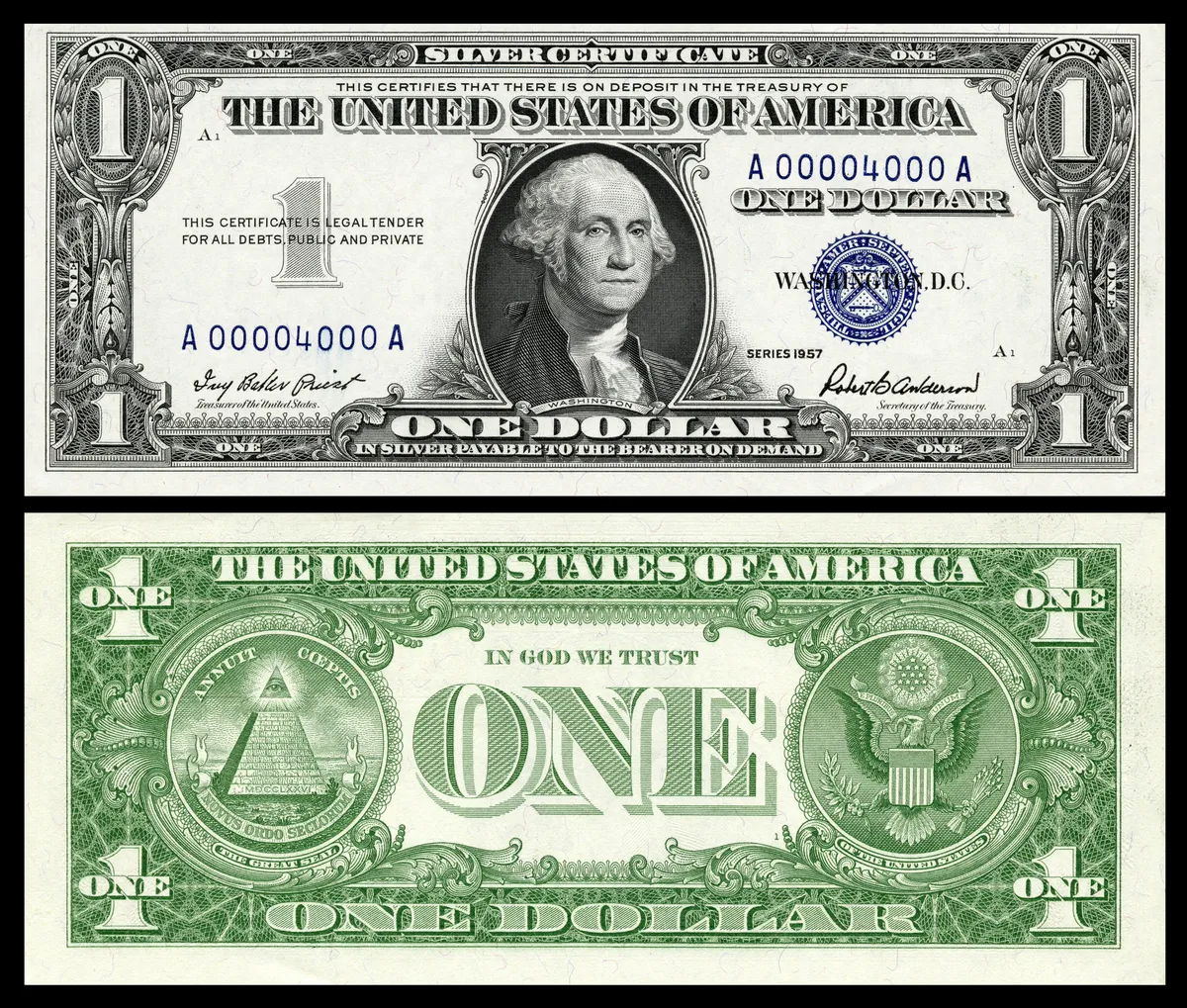
1957 Silver Certificate Value

A worn 1957 silver certificate is worth a little more than its $1 face value, and a crisp one is worth more. A star at the end of the serial number adds to the price.


What a 1957 silver certificate is worth today

The 1957 silver certificate is a $1 bill with a blue seal and the words SILVER CERTIFICATE across the top. It came in three versions: Series 1957, 1957 A and 1957 B. It was the first paper money to carry the motto IN GOD WE TRUST, and it entered circulation on October 1, 1957. These notes were printed in large numbers, so worn ones are common and sell for a small premium over face value. Crisp notes with no folds bring more. Notes with a star after the serial number were printed to replace faulty sheets, and they bring the most. You can no longer trade the note for silver: that ended on June 24, 1968.

Live prices are temporarily unavailable. The value of your own note depends on its condition and serial number.

How to tell which 1957 note you have

Look at the front of the bill. The words SERIES 1957 sit just below the portrait, on the right. If there is a letter after the year, you have the A or the B version. The seal on the right side is blue, and the words SILVER CERTIFICATE run across the top.

Then check the serial number in the lower left and upper right. It is printed in blue, like the seal. A small star at the end means the note replaced a faulty one at the printing plant. If your seal is not blue, the dollar bill value guide explains the other seal colours.

Series lettersSeries 1957, 1957 A and 1957 Ben.wikipedia.org
Face value$1en.wikipedia.org
Seal colourBlueen.wikipedia.org
Size6.14 by 2.61 inchesuscurrency.gov
Star in the serial numberReplacement for a defective noteuscurrency.gov

Why condition decides the price

Most 1957 notes spent years in wallets. A bill with soft paper, many folds and dirt sells for not much more than face value. If the paper still feels crisp and has only one or two folds, it sells for more. A note with no folds at all, sharp corners and bright paper brings the top price.

Don't wash, iron or flatten the bill. Buyers can tell, and a cleaned note sells for less than an honest worn one. Keep it flat in a paper envelope or a plastic sleeve made for currency.

  • Soft, limp paper with many folds: close to face value.
  • Crisp paper with a few folds: a small premium.
  • No folds and sharp corners: the best price for the series.

What makes this note different

Silver certificates once let the holder trade the bill for silver at the Treasury. The 1957 notes were the first paper money to carry IN GOD WE TRUST on the back. Some late 1935 silver certificates have the motto too, so check the year on the front rather than the back.

The last $1 silver certificates were printed in late 1963. After that, the $1 bill became a Federal Reserve Note with a green seal. That is why a blue seal dollar is now worth a little more than face. To see the other $1 notes worth checking, read the one dollar bill value page.

Entered circulation with the motto IN GOD WE TRUSTOctober 1, 1957en.wikipedia.org
Earlier $1 silver certificate series1935 to 1935 Hen.wikipedia.org
Last $1 silver certificates printedLate 1963en.wikipedia.org
Silver redemption endedJune 24, 1968en.wikipedia.org
Still legal tenderYes, at face valueuscurrency.gov

1957 Silver Certificate Value FAQ

Can I still trade a 1957 silver certificate for silver?

No. Silver redemption ended on June 24, 1968. The note is still legal tender for $1, but it is worth more to a collector.

Is a 1957 A or 1957 B worth more?

They sell for about the same in the same condition. Condition and a star in the serial number matter far more than the letter.

Is a 1957 star note rare?

Star notes were printed only to replace faulty notes, so they turn up less often than regular notes, and collectors pay more for them. The price table on this page covers regular notes. For a star note, ask a currency dealer.

How do I find the exact value of my note?

Look up the note by name with the [bill value checker](/check-bill-value/), pick your series, and compare the grades. Or photograph both sides and the app names the note and shows its value by grade.

Have the bill in your hand?

Photograph both sides and the app names the note and shows an estimated value for its condition.

Dollar Bill Scanner app icon

Dollar Bill Scanner

4.5 · 1,227 ratings on the App Store

Download on the App StoreGet it on Google Play

or scan with your camera to download for free

Where the figures on this page come from

Every number in this article is listed here with its source, last checked on October 26, 2026. Prices in the table are live catalogue estimates.

Series lettersSeries 1957, 1957 A and 1957 Ben.wikipedia.org
Face value$1en.wikipedia.org
Seal colourBlueen.wikipedia.org
Entered circulation with the motto IN GOD WE TRUSTOctober 1, 1957en.wikipedia.org
Earlier $1 silver certificate series1935 to 1935 Hen.wikipedia.org
Last $1 silver certificates printedLate 1963en.wikipedia.org
Silver redemption endedJune 24, 1968en.wikipedia.org
Size6.14 by 2.61 inchesuscurrency.gov
Still legal tenderYes, at face valueuscurrency.gov
Star in the serial numberReplacement for a defective noteuscurrency.gov

Dollar Bill Scanner

4.5· 1,227 ratings on the App Store

Scan your bills with your phone

Photograph both sides: the app names the banknote, shows its series and value by grade, and keeps your collection.

  • Bill scanner
  • Prices by grade
  • First scan free

Scan to get the app with your phone camera

Opens the app page - no typing needed.

Download on the App Store